
Mount Kenya Technical Climb, Nelion and Batian Peak 2026 – Rock Climbing in Kenya
Mount Kenya technical climbing targets the twin summits of Nelion (5,188m) and Batian (5,199m), requiring advanced alpine, trad, and multi-pitch skills (UIAA grade IV+ to V).
The most popular routes are the South East Face on Nelion and the North Face Standard Route on Batian, typically tackled in 5–8 days with certified guides for maximum safety.
Rock Climbing in Kenya
The North Face itinerary is suitable for the summer to fall (June – Sept) climbing season when the North Face of the peak is relatively snow-free and climbing conditions are best.
Mount Kenya Technical Climb 2026
The three summits of Mount Kenya
Mount Kenya actually has three main peaks: Batian, Nelion and Point Lenana.
While many guides offer ascent of all three summits, there are also options to only hike to Point Lenana.
Batian
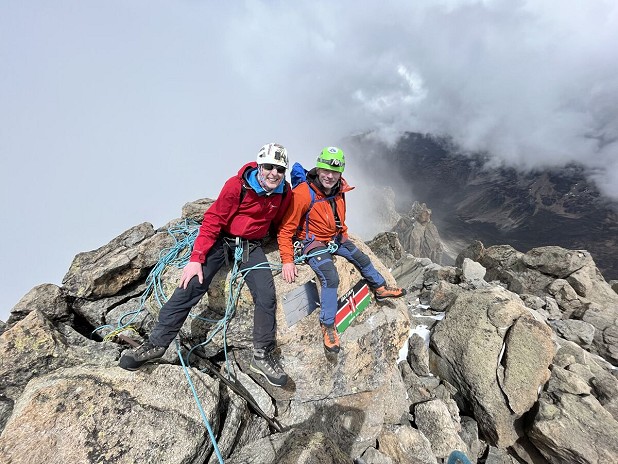
Batian is Mount Kenya’s highest peak and rises to 5,199 meters (17,057 feet) in elevation.
Nelion
Slightly lower on the massif you’ll find Batian’s slightly smaller twin peak of Nelion, at 5,188 meters (17,021 feet).
Rated as IV-, it serves as a good warm up for those attempting to summit Batian later in the morning.
This again is a challenging climb that requires experience with multi-pitch rock climbing to reach.
Mount Kenya Technical Climb
Point Lenana
The third peak and lowest summit on the Mount Kenya massif is Point Lenana, which rises up 4,985 meters (16,354 feet) in elevation.
We offer private guided ascents of Batian Peak, the true summit of the spectacular Mount Kenya. After the trek in and acclimatization, the technical climb is completed in one long day as a series of up to 21 pitches.
We provide technically qualified and experienced guides but the route is committing and long and participants would need to be familiar with leading long runouts, long abseils/rappels and putting in safe protection.
Controlling these risks relies on your own skills and experience as well as those of the guide.
When to climb
The North Face routes on Mount Kenya are usually climbed during the northern hemisphere’s summer (June through to August although September and early October could be a possibility too).
This means that there is less snow and ice, making climbing easier, with some sun on you and warmer rock.
The rainy seasons in Kenya are usually April, May and October/November.
Mount Kenya Technical Climb 2026
Suggested itinerary
| Day | Summary |
| 1 | Transfer from Embu town to the Chogoria National Park Gate where we take a 4×4 up towards Meru Banda’s |
| 2 | Trek from Meru Banda’s to the campsite at Lake Ellis |
| 3 | Trek from Lake Ellis to Minto’s Camp |
| 4 | Early start to reach Point Lenana via Austrian Hut for sunrise and descend to Shiptons Camp (or transfer to bivi point at base of Batian) |
| 5 | Climb Day: Batian Peak – Shiptons Camp |
| 6 | Climb Day: Spare day for poor weather – alternative climbs/trek if already summitted |
| 7 | Trek from Shiptons to Old Moses Camp |
| 8 | Trek from Old Moses to the Sirimon National Park Gate and transfer to Naro Moru |
Batian Peak difficulty
The summit climb is long, usually around 11 to 13 hours to complete with the base of the route at 4600m and topping out at 5199m.
Mount Kenya Technical Climb
Good acclimatization and fitness is essential, as well as the right kit for exposed conditions including mist, rain and snow and cold rock.
Trek Phase approaches the peaks from the east on the Chogoria route.
Terrain is forested initially, entering moorland and high alpine desert and eventually onto rocky glaciated landscape. A visit to Point Lenana for acclimatisation involves some scrambling on snow and ice.
The rock climb is usually between 16 and 21 pitches depending on rope length and confidence, group size and local conditions.
Pitches vary from sections of low grade scramble to around grade UIAA IV+ (UK V.Diff-Mild Severe, US 5.5) but with most being at around UIAA II (UKDiff, US5.3). This assumes we take the West side variation at Firmin’s Tower.
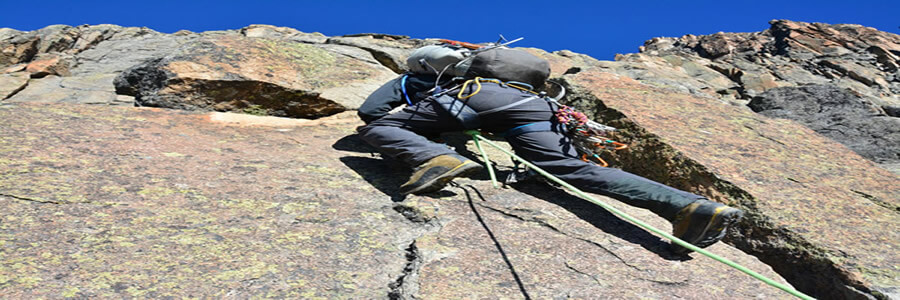
The rock is Nepheline Syenite which is similar to granite, blocky and abrasive with weathered fissures running vertically and horizontally offering good holds and friction.
However, there are loose boulders, rocks and sandy scree in the amphitheatres and easy-angled couloirs. Helmets are essential.
Technical Climbs Up Mount Kenya Batian Peak
If you are a proficient trad climber, you will love the challenge of Batian Peak, the true summit of Mount Kenya (5,199m). Previous technical rock climbing experience is required for this 21-pitch climb. All 21 pitches are done in one day, making this Mt Kenya summit not only a beautiful climb, but an exhausting one as well. This peak is best attempted in June through August.
Mount Kenya Technical Climb
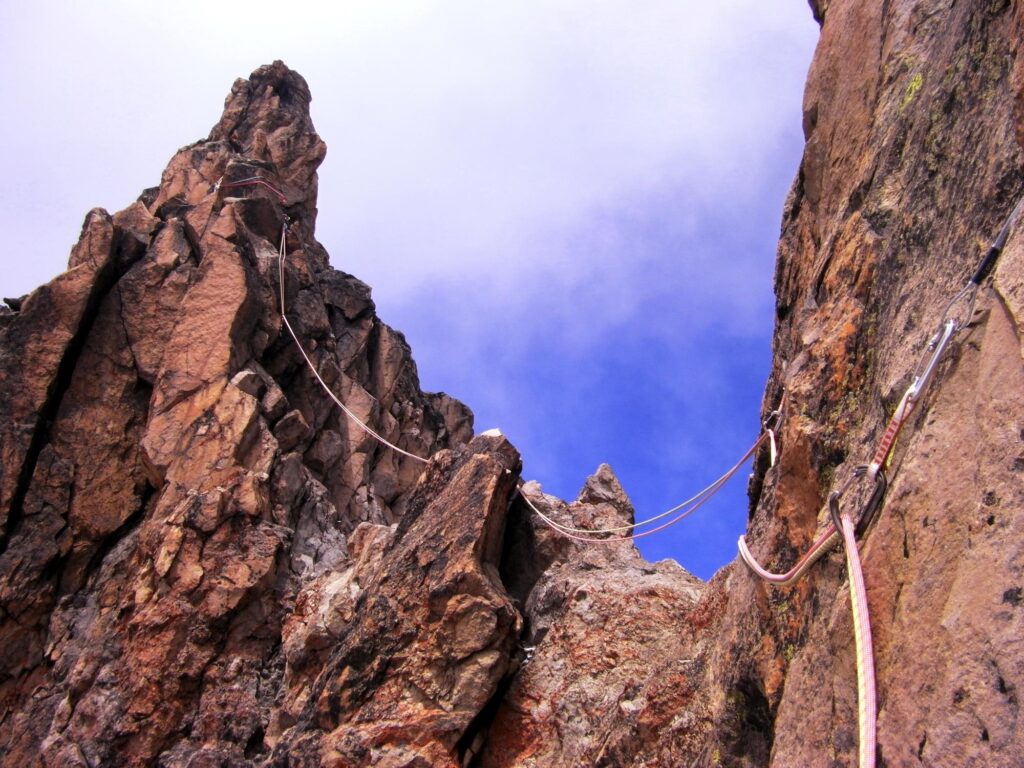
Almost all the standard belay points are made with slings around rock spikes and boulders. A couple have pitons in place and one or two have a drilled bolt.
Protection between belays is almost exclusively trad with self-placed nuts & cams placed and a few pitons along the way too.

Objective dangers
The first and most obvious is the length of the climb. An average rope-pair will take around 11 hours for the ascent and rappel back down.
Stamina at a fairly consistent grade will take energy, efficiency and concentration. Good past experience of similar routes will definitely help.
A second consideration is the altitude. Weight of bags and ropes and racks will appear much heavier at over 4000 metres.
Please keep hydrated, be fit and rest well.
Further considerations are the cold and weather.
Choose the right season and include a spare day for bad weather. It is common to have low visibility with thick mist, wet rock and a cold wind.
This route does not get the sun until well into the day.
Mount Kenya Technical Climb
Route finding is an issue, not just because of low visibility. The upper section in particular is not at all obvious and the abseil descent requires concentration and care.
But you will need to take bivi kit with you, since there is nothing in the hut.
There is quite poor communications on the mountain, except in the huts, and no official rescue team.
Overview
Mount Kenya Technical Climbing –
Mount Kenya Rock Climbing Batian 2026
Far from being a just single peak Mount Kenya is in fact a massif consisting of a multitude of imposing spires, cliffs, complex ridges and peaks. These are the weathered remnants of a large extinct volcano that was active several million years ago. Mount Kenya straddles the equator but is sufficiently high to receive significant snowfall and to be circled with several glaciers.
The main summits are the twins Batian and Nelion, and these can only be reached by means of technical climbing via a variety of rock or ice routes. The third highest peak, Point Lenana, is a popular destination for trekking parties. Point John and some of the other subsidiary peaks also offer good rock climbing routes.
Mount Kenya is the second highest peak in Africa and stands somewhat unjustly in the shadow of it’s taller neighbour Kilimanjaro, which lies some 320km away in the south and is visible on a clear day. Kili may see much more traffic – due to the possibility of summitting via several non-technical trekking routes and due to the sometimes dubious honour of being one of the Seven Summits – but Mount Kenya offers a wealth of excellent and diverse climbing possibilities on rock, snow and ice.
The rock on Mount Kenya can be of variable quality but is at it’s best high on the mountain where the syenite rock is similar to granite – rough, hard and well endowed with features.
Apart from the superb climbing potential on Mount Kenya, its tarns and alpine meadows; exotic, equatorial, high-altitude vegetation; sunbirds, hyrax and soaring eagles make the walk around the peaks one of the most beautiful expeditions in the East African mountains.
The main Mount Kenya climbing routes?
There are five main routes to reach point Lenana on Mount Kenya. It’s pretty common to combine these and to choose different trails for the ascent and descent.
This helps you control the time of your trip and it also means you get to see different scenery and experience the diverse landscapes surrounding the mountain.
If you wish to take on one of the two more technical summits, you will still first need to reach Point Lenana before carrying on.
Sirimon
The Sirimon route allows you to ascend more steadily and gives you a stunning approach to the final peak.
For this route, you’ll need a minimum of two days but it’s better to take an extra day to really adjust to the altitude.
This is one of the most popular routes to the summit and there are a few good things about this route: one is that it’s somewhat protected from the rainfall so the track stays drier.
The other is that there are two camps along the way, Old Moses at 3,300 meters (10,800 feet) and Shipton’s camp 4,200 meters (13,800 feet). This allows you to recharge on your way up and take the walk at your own pace.
So what are you waiting for? Make your next incredible outdoor adventure an incredible 5-day ascent of Mount Kenya via the Sirimon route!
Burguret
This route is excellent if you want to really feel alone on the mountain. Plus, you get to hike through some tropical rainforest at the start of the hike.
You’ll spend your night in wilderness huts. This is a challenging route as it’s used less often than others and there are times when you’ll have to hack your way through wild vegetation. It can also get pretty muddy.
On the upside, it’s a pretty special experience feeling alone as you hike up this majestic mountain. This trail takes a minimum of three nights and it’s ideal to combine it with a different trail for the descent.
Naro Moru
This trail is the shortest and most direct route. As such it is the most popular and tends to get quite busy.
The route is best suited for the descent (but also makes for a great ascent as well) as it’s relatively quick and easy. The plant life on offer on the way is also spectacular.
However, it has sections, such as the notorious Vertical Bog, which can get waterlogged.
This trail can be done in a long day but it’s better across two days and one night.
Looking for your next off-the-beaten-path adventure? Look no further than this incredible 5-day ascent of Mount Kenya via the Naro Moru route!
Chogoria
The Chogoria route is another awesome option for your ascent and/or descent of Mount Kenya.
It takes a bit longer, so you’ll need more time, but is well worth it. The scenery is spectacular and you’ll be able to take in views of waterfalls and an amazing gorge.
This descent takes around three days.
Hesitate no longer! Take a more scenic approach to climbing Mount Kenya and book a 6-day traverse via the Chogoria route today!
Timau
This is an older track and is really not used much these days.
It’s not the best route as there is nowhere to stay overnight along the way nor are there any facilities.
South Ridge route to Nelion
If you want to go beyond Point Lenana, Nelion is the next highest peak.
The route to this summit takes you along the south face of the mountain and the views along the way are breathtaking.
This route requires around eight hours of climbing with around 18 pitches. It’s a heavily technical climb that requires previous experience.
The descent is then done in three hours the next day. If you want, you can also extend your climb by crossing over to Batian, the highest peak via what is known as the “Gates of Mist”.
North face route to Batian
If you’ve not approached Batian already from Nelion, you can reach it via a climb on the north face of the mountain.
This is a more challenging climb and is for advanced climbers. It takes around 12 hours to ascend and then five to descend, which is done after a nights sleep on the mountain.
Technical Clothing
– Waterproof Jacket, breathable with hood
– Insulated Jacket, synthetic or down
– Soft Jacket, fleece or soft-shell
– 2 Long Sleeve Shirts, light-weight, moisture-wicking fabric
– Short Sleeve Shirt, light-weight, moisture-wicking fabric
– Waterproof Pants, breathable (side-zipper recommended)
– 2 Hiking Pants (convertible to shorts recommended)
– Fleece Pants – Shorts (optional)
– Long Underwear (moisture-wicking fabric recommended)
– 3 Underwear, briefs (moisture-wicking fabric recommended)
– 2 Sport Bra (women) Headwear
– Brimmed Hat, for sun protection
– Knit Hat, for warmth
– Balaclava, for face coverage (optional)
– Bandana (optional)
Handwear
– Gloves, warm (waterproof recommended)
– Glove Liners, thin, synthetic, worn under gloves for added warmth (optional)
Footwear
– Hiking Boots, warm, waterproof, broken-in, with spare laces
– Gym Shoes, to wear at camp (optional) – 3 Socks, thick, wool or synthetic
– 3 Sock Liners, tight, thin, synthetic, worn under socks to prevent blisters (optional)
– Gaiters, waterproof (optional)
Accessories
– Sunglasses or Goggles
– Backpack Cover, waterproof (optional)
– Poncho, during rainy season (optional)
– Water Bottle (Nalgene, 32 oz. recommended
– Water Bladder, Camelback type (recommended)
– Towel, lightweight, quick-dry (optional)
– Stuff Sacks or Plastic Bags, various sizes, to keep gear dry and separate Equipment
– Sleeping Bag, warm, four seasons
– Sleeping Bag Liner, for added warmth (optional)
– Trekking Poles (recommended)
– Head lamp, with extra batteries
– Duffel bag, (waterproof recommended) for porters to carry your equipment.
– Daypack, for you to carry your personal gear
Other
– Toiletries (Option)
– Prescriptions
– Sunscreen
– Lip Balm
– Insect Repellent, containing DEET
– First Aid Kit
– Hand Sanitizer
– Toilet Paper (To be provided)
– Wet Wipes (recommended)
– Snacks, light-weight, high calorie, high energy (optional)
– Pencil and Notebook, miniature, for trip log (optional)
– Camera, with extra batteries (optional)